Tires · Alignment · Suspension
Six real-world cases — from bad alignment to worn shocks to driving habits. Find the actual cause before you buy another set of tires.
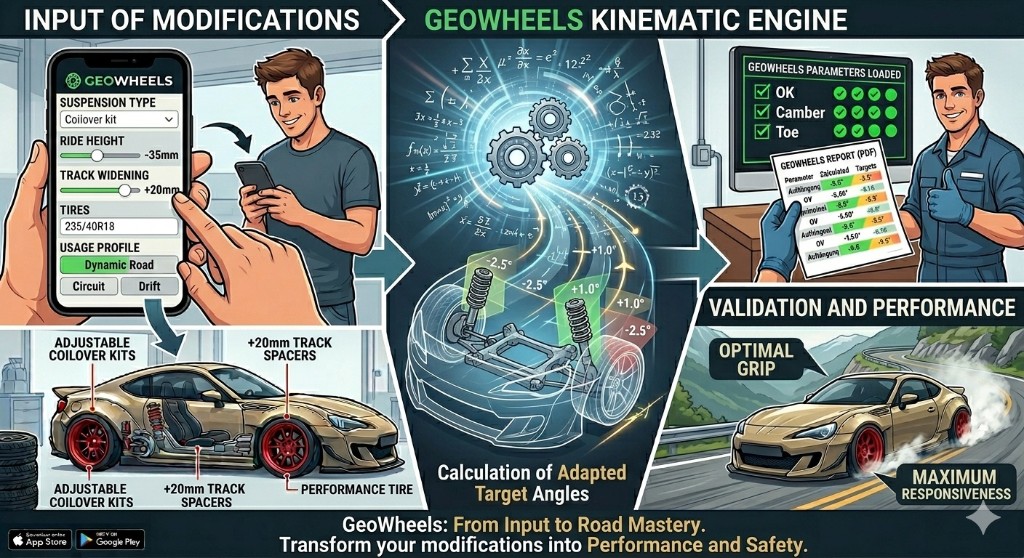
Short answer: most premature tire wear comes from alignment plus mechanical state, not from tires alone. GeoWheels helps translate your actual setup into usable rack targets (camber, toe, caster, thrust angle) so the next alignment addresses the root cause before you invest in another set of tires.
Case 01
Excessive Camber
AlignmentWhen wheels lean too far in or out — common after a lowering job — only part of the tread contacts the road. One shoulder disappears long before the other.
Case 02
Incorrect Toe
AlignmentToo much toe-in or toe-out makes the tire scrub sideways with every foot it travels. The rubber doesn't wear down — it gets scraped off at an angle.
Case 03
Wrong Tire Pressure
UsageUnder-inflated: the shoulders carry all the load, the center lifts. Over-inflated: only the center contacts the road. Either way, wear is uneven and accelerated.
Case 04
Worn Shocks or Struts
MechanicalA dead shock absorber lets the wheel bounce freely after every bump. The tire loses contact with the road and slaps back down repeatedly, punching flat spots into the tread.
Case 05
Aggressive Braking
UsageHard, repeated braking near the lock-up threshold generates localized heat spikes. The rubber tears away in chunks instead of wearing progressively.
Case 06
Rear Axle Thrust Angle
AlignmentA misaligned rear axle points the rear tires slightly sideways relative to the vehicle's true direction of travel — even on a straight highway. The result is continuous lateral scrub.
Before buying new tires, identify the cause. A fresh set mounted on a bad alignment will wear the same way — sometimes faster. The logical sequence: check tire pressure (2 minutes, cold), visually inspect shocks and struts for leaks or excessive bounce, then get a full four-wheel alignment at a shop. GeoWheels helps you cross-reference your measured angles against the OEM specs for your specific vehicle.
Camber, toe, caster, thrust angle — compare your shop's readings against factory targets in real time.
Download GeoWheelsPremature tire wear is rarely caused by a single factor. In most shop scenarios, two or more causes interact — degraded alignment amplified by low pressure, or worn shocks masking a rear thrust angle problem. This study details six common cases: their physical mechanisms, wear signatures, and correction sequences. Vehicle examples are drawn from common US platforms where the failure mode is frequently documented.
Case 01
Excessive Camber
AlignmentCamber is the angle of the wheel relative to vertical. Negative camber tilts the top of the wheel inward. A small amount is intentional — it improves cornering contact patch geometry. Excessive negative camber, however, shifts the entire contact patch toward the inner shoulder, which then bears a disproportionate share of the vehicle's weight.
On lowered vehicles, negative camber increases mechanically as ride height drops, driven by the fixed pivot geometry of the suspension arms. On a MacPherson strut front (Mustang S550, Camaro) or a multi-link rear (Dodge Charger, Challenger), the effect is predictable but often overlooked until the inner shoulders are already gone.
| Scenario | Typical Camber | Wear Impact |
|---|---|---|
| Stock ride height | −0.5° to −1.2° | Minimal if toe is correct |
| Moderate lowering (−1 in.) | −1.5° to −2° | Noticeable inner shoulder loss |
| Aggressive lowering (−2 in.+) | −2.5° to −4° | Rapid inner wear, structural risk |
Inner shoulder worn through to or near the wear indicators; outer shoulder still showing significant tread depth. On a radial cut, the inner carcass shows visible deformation from sustained overload. The depth difference between inner and outer edge can reach several millimeters in severe cases.
Eccentric camber bolts (front strut on most platforms), adjustable upper control arms, or aftermarket camber correction plates. On the rear, dedicated camber links or adjustable trailing arms depending on the suspension design. On severely lowered vehicles, camber correction alone is insufficient — a full four-wheel alignment (camber + toe + caster) is required to restore a coherent geometry.
Case 02
Toe Out of Spec
AlignmentToe is the angle of the wheels as seen from above — toe-in means the fronts of the tires point slightly toward each other; toe-out is the opposite. Any deviation from spec means the tire is rolling in a direction that differs from the vehicle's actual path. The tire compensates through continuous lateral scrubbing — the rubber doesn't compress against the road, it is abraded sideways across it.
At 1° of excess toe, the lateral scrub rate equates to several feet of sideways sliding per mile driven. On trucks like the Ram 1500 or Silverado running all-terrain tires, the block edges of the tread make this particularly destructive — the sharp tread knobs load and release asymmetrically with every rotation.
| Toe Error | Estimated Lateral Scrub | Effect |
|---|---|---|
| < 0.1° deviation | Negligible | Within OEM tolerance |
| 0.3° – 0.5° | Perceptible | Accelerated edge wear |
| > 0.8° | Significant | Feathering, tire life cut in half or worse |
The tread edge presents a "feathered" or "sawtooth" texture when dragged across by hand — smooth in one direction, sharp in the other. Unlike camber wear, the tread may still look acceptable in depth from above, masking significant structural degradation at the shoulder. The feathering direction indicates whether toe-in or toe-out is the culprit.
Front toe is adjusted at the tie rod ends; rear toe at the rear toe links or adjustable trailing arms. Critical rule: toe must always be set after camber, never before. Any camber adjustment shifts the toe angle dynamically — setting toe first and then correcting camber invalidates the toe setting.
Case 03
Incorrect Tire Pressure
UsageTire pressure determines the shape of the contact patch. At the correct pressure, the footprint is approximately rectangular and uniform. Under-inflated, the center of the tread lifts away from the pavement and both shoulders carry the load — the tire flexes excessively on every rotation, generating internal heat that degrades the rubber compound and weakens the carcass over time.
Over-inflated, the contact patch narrows to a thin strip along the center; the shoulders lift. The over-inflated tire also transmits more of every road impact directly to the carcass and wheel, increasing the risk of impact damage (sidewall bulge, bead separation) on rough roads or when hitting potholes — common on US highway conditions.
| Deviation from Target Pressure | Effect |
|---|---|
| −4 psi (under-inflated) | Shoulder wear, +2–3% fuel consumption, reduced handling precision |
| −8 psi or more | Structural risk, potential bead loss at speed |
| +4 psi (over-inflated) | Center strip wear, impact sensitivity, harsher ride |
Under-inflated: both shoulders heavily worn, center tread still present — visually a "cupped" cross-section. Over-inflated: center strip worn through, shoulders still showing tread depth. Left-right pressure asymmetry (common when pressure is rarely checked) can produce a hybrid pattern that mimics camber or toe error, complicating diagnosis.
Check pressure monthly, always cold (vehicle parked at least 3 hours). Hot pressure runs 3–6 psi above cold — never bleed a hot tire to hit the cold target. On trucks or SUVs running different load conditions (empty vs. towing), adjust pressure to the load-rated values printed on the door jamb sticker, not the tire sidewall maximum.
Case 04
Worn Shock Absorbers or Struts
MechanicalA shock absorber's function is to convert suspension kinetic energy into heat via hydraulic damping. When the internal seals or valving degrade, the shock no longer controls the wheel's rebound rate. After hitting a bump, the wheel bounces freely — oscillating vertically at the suspension's natural frequency (typically 1–2 Hz on most trucks and SUVs) instead of returning smoothly to the road surface.
Each bounce-and-slap cycle generates a discrete impact at the tire contact patch. Over thousands of miles, these repeated impacts remove rubber at regular intervals around the circumference rather than uniformly across the tread — producing the characteristic cupping or scalloping pattern.
Regular concave scallops (cupping) spaced evenly around the tire circumference. The tire may appear visually acceptable in a static inspection but vibrates noticeably above 60–70 mph because the scallops create an out-of-round condition. Balancing a cupped tire does not eliminate the vibration — the issue is the tread profile, not weight distribution.
Replace shocks or struts in axle pairs (both fronts or both rears together). On lifted vehicles such as the Wrangler JL or Tacoma, verify that the replacement shock's extended/compressed length matches the lift height — running a stock-length shock on a 3-inch lift puts the unit outside its designed travel range, causing premature seal failure.
Case 05
Aggressive Braking & Thermal Damage
UsageDuring hard braking, the tire is subjected to a combination of shear stress (the wheel decelerates while the vehicle's mass tries to keep it moving) and thermal loading. Even without a full lockup event, repeated maximum-effort braking generates localized heat spikes in the contact patch. The rubber compound, softened above a critical temperature threshold, tears away in chunks rather than abrading progressively.
On high-output platforms like the Hellcat or GT500, the front tires are particularly exposed during track days or aggressive street use. The factory summer performance tires fitted to these vehicles are optimized for grip at operating temperature — but sustained overloading burns through the compound at a rate that bears no relationship to normal mileage estimates.
Discrete flat spots with visible heat discoloration (surface appears glazed or slightly darker). Rubber loss is localized and uneven rather than gradual. Smell of burned rubber after use. On track, both front tires typically show the pattern symmetrically; on street, it often appears on the tire taking the higher braking load based on brake balance.
Driving technique: progressive brake application, threshold braking training. For dedicated track use: tires rated for sustained high-temperature operation (performance street-to-track compounds, semi-slicks). Verify brake balance — a rear-biased or front-biased proportioning valve overloads one axle's tires prematurely. Check brake pad compound compatibility with the intended use: high-friction track pads on street use generate thermal peaks the OEM tire spec doesn't account for.
Case 06
Rear Axle Thrust Angle Misalignment
AlignmentThe thrust angle is the angle between the geometric centerline of the vehicle and the actual direction the rear axle pushes the vehicle forward. On a perfectly aligned vehicle, these are identical (0° thrust angle). When the rear axle is offset — through a bent housing, worn rubber bushings, or a shifted subframe — the rear tires point in a direction slightly different from the vehicle's true direction of travel.
The result is continuous lateral drift of the rear tires, even in a straight line. Unlike toe error at a single wheel, thrust angle misalignment affects both rear tires simultaneously and forces the front steering to compensate — the driver unconsciously holds a slight steering correction, which adds front tire lateral loading on top of the rear wear.
On solid axle trucks (Suburban, Expedition, older F-250/F-350): bent axle housing from off-road impact or overloading; worn or collapsed leaf spring center bolt allowing axle walkout. On IRS platforms (newer Expedition, Ram 1500 with coil rear): degraded rear toe links or subframe bushings shifting the entire cradle. On 4WD trucks after lift installs: improper pinion angle correction that inadvertently shifts axle centerline laterally.
Lateral wear concentrated on one side of both rear tires simultaneously. At highway speed, persistent pull or drift to one side even after front toe has been corrected. Classic diagnostic tell: the vehicle tracks straight but the steering wheel sits slightly off-center.
Adjustable rear toe links (IRS) or rear axle repositioning (solid axle). If the cause is structural — bent housing, cracked spring perch, shifted subframe — the geometry correction cannot substitute for replacing or repairing the damaged component. On lifted solid axle trucks, verify axle centering with a tape measure between the axle and frame before the alignment rack: rack measurements alone won't reveal lateral axle walkout.
| # | Cause | Category | Typical Signature | Correction Priority |
|---|---|---|---|---|
| 01 | Excessive camber | Alignment | Inner shoulder gone, outer intact | High |
| 02 | Incorrect toe | Alignment | Feathering, diagonal tread scrub | High |
| 03 | Wrong tire pressure | Usage | Both shoulders (low) or center strip (high) | Immediate |
| 04 | Worn shocks / struts | Mechanical | Cupping, vibration above 65 mph | Critical |
| 05 | Aggressive braking | Usage | Flat spots, heat glazing, local rubber loss | Use-dependent |
| 06 | Thrust angle (rear axle) | Alignment | Lateral rear wear, off-center steering | High |
Top cause type
Align.
3 of 6 cases are alignment-driven
Wear doubles at
0.8°
toe error above this threshold
Quickest check
2 min
verify pressure cold, first
Combined causes
Common
rarely a single root cause
GeoWheels visualizes camber, toe, caster, and thrust angle — compare your shop's printout against factory specs and modified-vehicle targets in one view.
Download GeoWheels